


There are many sites out there that explain composting in detail, how to do it properly, how it actually works, all that good stuff. There are also plenty that talk about apartment composting, all the equipment you need, and I’m sure that is all well and good. I’ve even listed a few below in the related links. But I decided to write this article to explain how I do it, what I have learned, and the equipment that I use. I am by no means a pro at this, and I’m not even claiming that I know what I’m doing, however I feel like I have been mostly successful with my apartment style composting, and want to share. However if you are reading this article it is likely that you don’t.

First off, I will say that I am simple, all I use is a plastic bin (actually one of those plastic tote that is used for storage) that I bought from Target. I’m not sure the size, I would guess maybe 5 or 10 gallons. I drilled a couple holes in the bottom for drainage, but have found that it wasn’t really necessary as long as you aren’t overloading the big. To start, put in some dirt, sand, leaves, newspaper — anything to line the bottom a few inches. I don’t use standard newspaper because of the inks, but it would still work fine. However I do use newspaper from a mailing I get that I know is printed with soy based inks. Make sure that if you are using newspaper you tear it into pieces that are pretty small, nothing bigger than one inch by one inch.
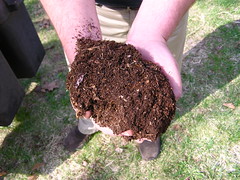
Let me now tell you that I did learn quickly that this simple set up cannot handle all vegetable scraps that I generate. So I have learned what composts quickly and what doesn’t, and I stick to using only those. You will figure this out soon enough. When I put too much in it started to stink and get too juicy. Another reason for this was that I didn’t have enough green and brown dry matter (ie leaves, grass, etc) in there, so it stayed too wet and the moisture balance was thrown off. It will also help if you keep the food scraps very small. The bigger they are the longer they will take to break down. This means don’t drop an entire banana peel in whole, make sure to break it into smaller pieces.
So now you have your container with some lining on the bottom. All you have to do now is put your scraps in, and make sure to cover them up. If you don’t, the bin will attract flies and probably won’t break down as quickly. Just enough to cover it so there is no exposed food should be enough to keep the flies and the stink away. Something else I do that seems to help the process is to only add scraps once or twice a week, rather than after each meal. With a container you have limited space, and if you add it piecemeal it becomes hard to keep it all covered, and if you have just little pieces of food spaced out all over in my experience it takes longer to break down than if you keep the moist scraps together. It seems to generate more heat this way, break down quicker, and then I can mix it into the bulk sooner. So if you collect scraps for a few days, then add them in and cover them, I would say within a week you can turn the mixture. This will let it aerate and again speed the process. Likely you will feel heat coming off of it, which means that it is working.
I had started out keeping it covered thinking it would keep flies away, but I learned that it was unnecessary. Also, I will say that I don’t actually keep this bin indoors, so I am able to get away with not keeping it perfectly sanitary. I am lucky to have some outdoor space where I can keep the bin.
Another thing that I have done, since the container is fairly small and the process ongoing is to keep a second bin for secondary composting. So when part of the bin is nice and dark and starting to look like soil, I scoop that into the second bin where I let the process continue, and in this bin it can dry out and is ready for use in my garden! This keeps the first bin actively composting, and I can always be adding to it.
It may sound confusing, but really there are just a few basics:
- Try to at least 1/3 of the content dry (leaves, grass clippings, etc)
- Always keep wet scraps covered
- Turn mixture every few days to keep the composting process active
It is pretty simple, and you will quickly learn what works for you in your area and conditions. Feel free to share any tips you have. Also, keep in mind that this is just what works for me. I am not a professional.
More reading:
- Compost Instructions – Learn how to make compost, and why improving your soil is the best thing that you can do for your lawn and garden
- Composting 101
- Journey to Forever – Indoor Composting
- How to Compost
- See more about me and Idealist Cafe
- Add Idealist Cafe to your feed reader
- Or maybe sign up to get free updates by email
- Liking Idealist Cafe on Facebook is a good option
- Catch more frequent and random updates on Twitter
- Just reading this article is cool too! :)
Originally posted on Thursday, September 18th, 2008 at 12:43 PM .


What do you mean by keeping the scraps "covered" is that by the dry stuff? or… by… ??
Thanks for the article!
Hi Jeanne. Yea, so when you put scraps in if they are exposed they will attract bugs. But just a thin layer of dry stuff over the top is fine. Dirt, more finished compost, grass clippings, shredded leaves, any will work. You just want those scraps to not be exposed. A lot of this stuff you will just figure out along the way as you have problems or questions. If there are a bunch of bugs hovering over it, just cover if over a little more. If it is staying too wet with scraps, you will also know because it will begin to stink, in which case you just need to add more brown or dry matter.
Thanks for reading!
So let me get this straight– you don't use a composter? You didn't spend $489.99 on a composter, and it still works? I've never composted before, and I'm interested in starting, but everything I've read so far says you have to have a special container. Hmmm
The fancy equipment will help for sure but is not necessary. But to compost indoors you need to be diligent in turning it regularly and also keep any scraps covered and not exposed to the air otherwise the flies will come. It will probably go quicker with the fancy equipment, but I can personally attest to the fact that I had nothing but a bin and successfully composted indoors.
Ummmm, you just rocked my world with this post! I found the link to this post at http://bohemianrevolution.com/composting-in-an-apartment/ and I have been trying to figure out how to compost in my apartment in a way that does not use worms and does not indicate that, well, food is rotting in the corner of the balcony. I am going to Target right now! Thank you Thank you Thank you!
No problem Brandi, hope it works out for you. Feel free to come back here and let me know how it goes. Happy composting!
Hello, I live in a small apartment and I grow some vegetables on my veranda. I use organic soil and aware that my soil needs more nutrients. I want try your composting method but I am wondering how temperatures affect the composting process. In my region, it gets really hot and the temperature rises around 85-95F or higher during summer and it drops to bellow 30F and lower during winter. I am particularly concerned about odor during summer since I share the veranda with my neighbor. Thanks!
Ayako, I believe that the higher temperatures would make the process go faster. I am not sure about if it gets below freezing. That may pose a problem… To keep the odor down during the summer, you just have to be sure to keep any food scraps covered. As long as they are fully covered they will not stink and will only attract a minimal amount of flies. You can use grass clippings, leaves, regular soil or shredded newspaper to cover the scraps. Also, be sure that you keep enough dry matter in there to offset the wet stuff that you are adding. The only times I had problems with odor or flies was when the compost got too wet and started to rot, in which case I just added more dry matter and it balanced it back out. You will just have to experiment and see what works best. And remember, I’m not a professional at this, everything I’ve written about here is just from my own research and experience. 🙂 Thanks for reading!
Hi Russ, thank you for your response! Ok, I should not worry too much about odor and flies but will focus on adding enough dry things to wet food scrapes. I use a lot of vegetables in my diet and fill a trash can with unwanted parts (e.g., skins) fairly quickly. Until I reached your blog, I believed that composting is privilege only for people who have their own yards! Now I have a better idea and I will start composting as soon as I accumulate enough food scrapes! Thank you again for sharing your experience and advice.
Glad to help! Now I am lucky in that I do have a yard, but at the time I wrote this I was in a rental and did successfully compost in a bin for several years. Good luck, and let me know how things work out for you!
Hey thanks for this post! I started my bin, but i think my newspaper scraps are too big. Is that going to affect the health of my compost?
Hi Nate, I don’t think have big paper scraps will affect the health of your compost, though the larger they are the longer they will take to break down. The only other potential problem I can see with large pieces of paper is if they get wet they may hold moisture and increase the chances of the pile rotting and getting messy and stinky.
Now that I have my compost in my yard, I don’t worry as much about these small details, and have the luxury of I using more leaves and grass clippings rather than newspaper, but when I have paper that is printed with soy inks, I do shred those and add to the compost. But I tear them into small pieces before doing so. You will learn what works best over time. Good luck and thanks for reading!
Thanks on your marvelous posting! I quite enjoyed reading it, you may be a great author.I will always bookmark your blog and definitely will come back sometime soon. I want to encourage one to continue your great work, have a nice day!
I was wondering about the temperature. If I compost can I do it in my garage during winter if the temperture is around 30-40 degrees inside. In the summer it starys areound 80, so I don’t think that this is an issue in the summer. If it needs to be warmer than I need to figure out where to do this in my home. Thanks!
I am not certain as I live in San Diego and it never gets that cold. I would imagine when it’s cold the process will slow down, of course it is freezing there will be no smell either, so I don’t know. You may want to do a search to find out from people who live in colder climates. Thanks for reading!